The core 1934 patent
The central U.S. patent is US1962565A, "Apparatus with circuits oscillating under multiple wave lengths". It was filed in the United States on November 13, 1931, claimed a French priority date of May 2, 1931, and was patented on June 12, 1934.
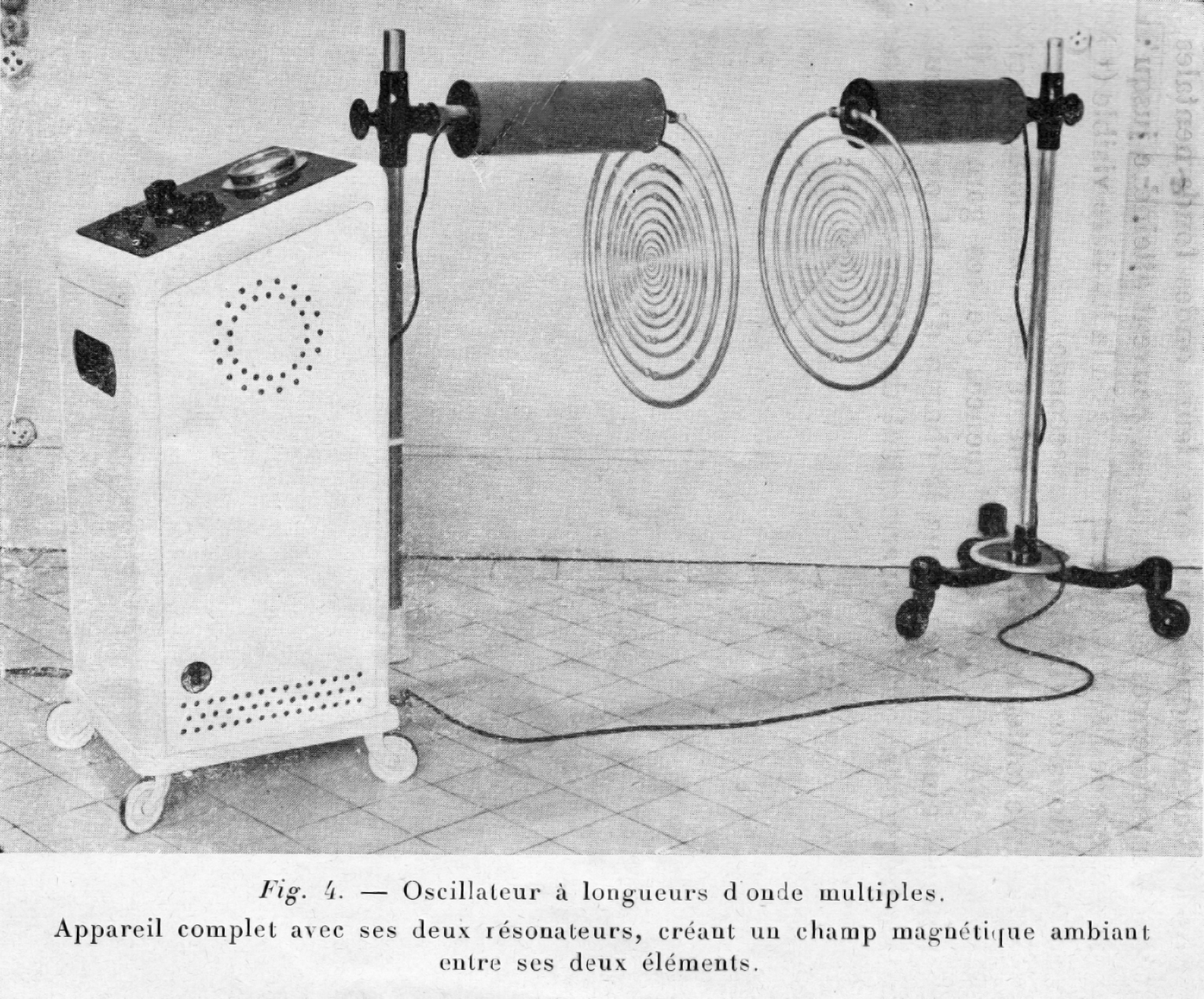
The patent's stated object was an apparatus able to send out multiple wavelengths at the same time. Its radiating part was a series of concentric, insulated, split rings of different diameters. The gaps and small terminal spheres mattered because each open circuit had its own inductance and capacity.
What the rings were doing
In the patent, the rings could be arranged in one plane or as a three-dimensional surface such as a cone, sphere, paraboloid, or ellipsoid. A transformer, spark gap, condenser, and self-induction coils excited the system. Some rings could be connected directly while others were excited by induction.
That means the MWO patent is primarily a high-frequency radiating-circuit design. Later medical claims are historically attached to it, but they are not proven by the electrical patent itself.
For practical geometry context, see Lakhovsky coil dimensions and the open-ring coil calculator. Both keep the distinction between patent geometry and therapeutic claims explicit.
The French filing and BnF record
The local research archive also captured FR732276A metadata for "Oscillateur a ondes multiples," published in France in 1932. A BnF bibliographic record exists for a related title, "L'oscillateur a longueurs d'onde multiples." Full official scans for some French materials remain a research gap.
The later tube patent
US2351055A, patented in 1944 after Lakhovsky's death, describes a tube containing multiple-wave-length producing or conducting means. The patent names George Lakhovsky, notes Anne-Marie Louise Lakhovsky as administratrix, and frames the design as a simplification of apparatus disclosed in the 1934 patent.
The important historical point is continuity: the later patent refers back to US1962565A, but changes the form factor toward a tube-like unit that could be easier to use.
What modern replicas add
Modern MWO pages often add safety claims, wellness claims, construction recipes, or frequency interpretations that are not in the original patent language. Those may be modern secondary interpretations, but they should not be presented as primary Lakhovsky evidence unless traced to a specific patent, book, laboratory note, manual, or contemporaneous report.